
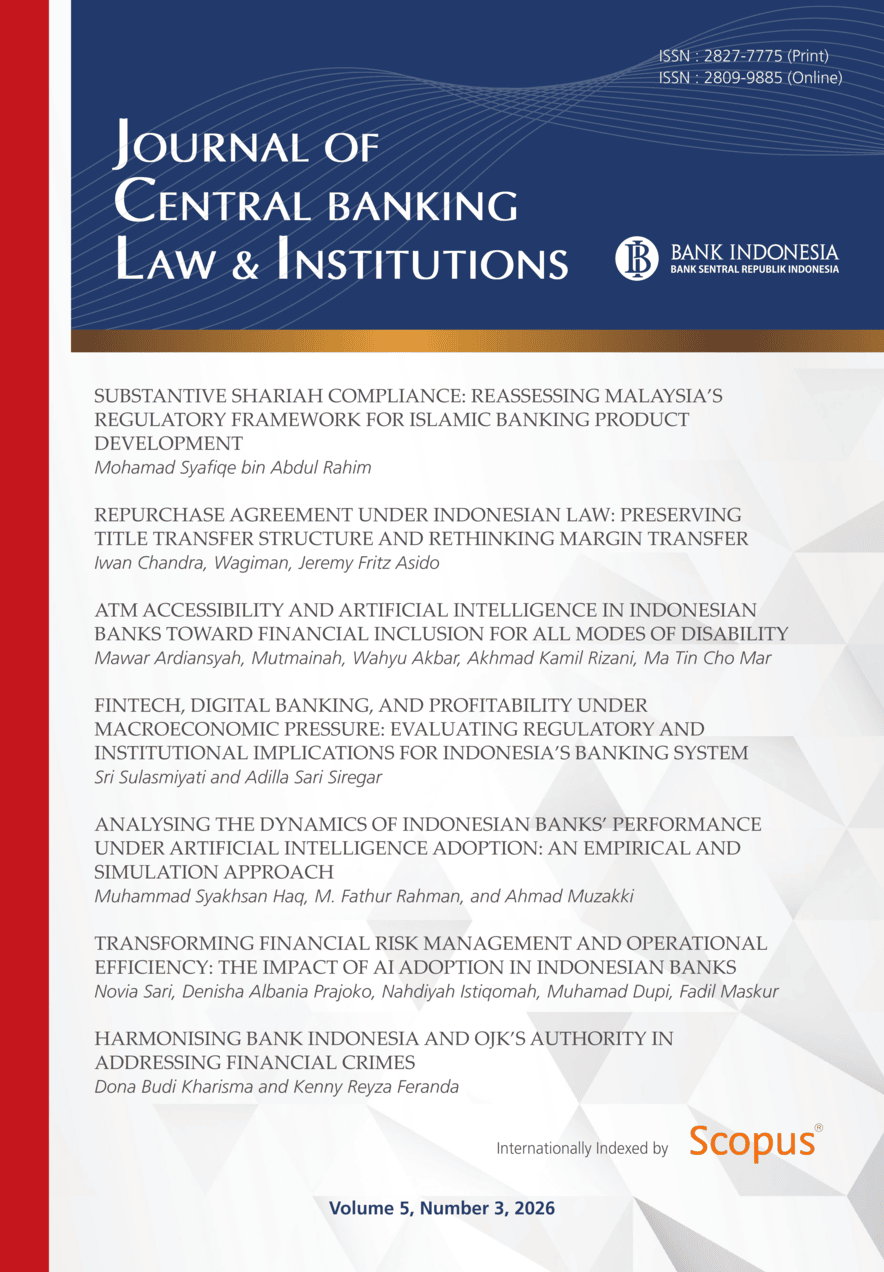
Transforming Financial Risk Management and Operational Efficiency: The Impact of AI Adoption in Indonesian Banks
##plugins.themes.academic_pro.article.sidebar##

Downloads
##plugins.themes.academic_pro.article.main##
Abstract
This study investigates the impact of Artificial Intelligence (AI) adoption on operational efficiency and financial risk management in six major Indonesian banks: BNI, BRI, BCA, Danamon, Mandiri, and CIMB Niaga. The research implements Difference-in-Difference (DiD) methodology coupled with Bayesian Vector Autoregression (BVAR) Scenario Testing to assess how AI affects financial indicators comprising NPLs, ROA, CAR, and LDR. The study shows that AI adoption yields minor, immediate results but does not produce substantial improvements in financial performance or risk management when moving beyond Level 3. AI improves operational performance by enabling automated processes and optimised decisionmaking, leading financial institutions to enhance their fraud detection, credit risk management, and liquidity risk management. The study demonstrates the value of implementing AI through an orderly strategic plan while mandating that organisations establish rules and ethical guidelines for AI use throughout its adaptation stages. The implementation of AI by Indonesian banks offers multiple prospects to enhance their operational performance, risk management capabilities, and financial stability over the years.
##plugins.themes.academic_pro.article.details##
References
- Agustiawan, Dede Arisko. “Digital Banking Transformation AI Enhances Efficiency and Customer Experience Seminar Perspective Industry.” WACANA: Jurnal Ilmiah Ilmu Komunikasi 23, no. 1 (2024): 191–200. https://journal.moestopo.ac.id/index.php/wacana/article/view/4130/1579.
- Akbary, N. M. M., Trinugroho, I., Risfandy, T., & Pamungkas, P. (2025). Digital Transformation and Efficiency: Evidence from Indonesian Banks. International Journal of Business and Society, 26(1), 135–150. https://doi.org/10.33736/ijbs.9555.2025.
- Al-Ababneh, Hassan Ali, Victoria Borisova, Alina Zakharzhevska, Polina Tkachenko, and Natalia Andrusiak. “Performance of Artificial Intelligence Technologies in Banking Institutions.” WSEAS Transactions on Business and Economics 20 (2022): 307–317. https://doi.org/10.37394/23207.2023.20.29.
- Alzaidi, Amer Awad. “Impact of Artificial Intelligence on Performance of Banking Industry in Middle East.” IJCSNS International Journal of Computer Science and Network Security 18, no. 10 (2018): 140. http://paper.ijcsns.org/07_book/201810/20181021.pdf.
- Angrist, Joshua D., and Jörn-Steffen Pischke. Mostly Harmless Econometrics: An Empiricist’s Companion. JSTOR, 2009. https://doi.org/10.2307/j.ctvcm4j72.
- Barongo, Rweyemamu Ignatius, and Jimmy Tibangayuka Mbelwa. Using Machine Learning for Detecting Liquidity Risk in Banks. Machine Learning with Applications 15 (2024): 100511. https://doi.org/10.1016/j.mlwa.2023.100511.
- Castillo-Martínez, Isolde Margarita, Daniel Flores-Bueno, Sonia M. Gómez-Puente, and Victor O. Vite-León. “AI in Higher Education: A Systematic Literature Review.” Frontiers in Education 9, no. 2 (2024). https://doi.org/10.3389/feduc.2024.1391485.
- Chaising, Supansa, Muhammad Syukur, and Phasuk Nithibandanseree“Comparison of Machine Learning Algorithms for Prediction
- of Total Assets.” 2023 International Conference on Cyber Management and Engineering (CyMaEn), IEEE, 2023, 255–259. https://doi.org/10.1109/CyMaEn57228.2023.10051085.
- Daiya, Harsh. “AI-Driven Risk Management Strategies in Financial Technology.” Journal of Artificial Intelligence General Science (JAIGS) 5, no. 1 (2024): 194–216. https://doi.org/10.60087/jaigs.v5i1.194.
- Doumpos, Michalis, Constantin Zopounidis, Dimitrios GounopoulosEmmanouil Platanakis, and Wenke Zhang. “Operational Research andArtificial Intelligence Methods in Banking.” European Journal of OperationalResearch 306, no. 1 (2023): 1–16. https://doi.org/10.1016/j.ejor.2022.04.027.
- Fethi, Meryem Duygun, and Fotios Pasiouras. “Assessing Bank Efficiency and Performance with Operational Research and Artificial Intelligence Techniques: A Survey.” European Journal of Operational Research 204, no. 2 (2010), 189–198. https://doi.org/10.1016/j.ejor.2009.08.003.
- Gao, R., Tompaidis, S., & Arora, R. (2024). Choosing Scenarios to Estimate Resilience and Stress Test Financial Institutions. Management Science. Advance online publication. https://doi.org/10.1287/mnsc.2024.06126.
- Ghandour, Ahmad. “Opportunities and Challenges of Artificial Intelligence in Banking: Systematic Literature Review.” TEM Journal 10, no. 4 (2021): 1581–1587. https://doi.org/10.18421/TEM104-12.
- Goswami, Utsav, and Rashi Mittal. “The Role of Artificial Intelligence in Financial Decision-Making.” International Journal of Scientific Research in Engineering and Management 8, no. 4 (2024): 1–5. https://doi.org/10.55041/ijsrem32690.
- Hendry, David F., and Michael P. Clements. “Pooling of Forecasts.” The Econometrics Journal 7, no. 1 (2004): 1–31. https://doi.org/10.1111/j.1368-423x.2004.00119.x.
- Jain, Rita. “Role of Artificial Intelligence in Banking and Finance.” Journal of Management and Science 13, no. 3 (2023): 1–4. https://doi.org/10.26524/jms.13.27.
- Koop, Gary, M. Hashem Pesaran, and Simon M. Potter. “Impulse Response Analysis in Nonlinear Multivariate Models.” Journal of Econometrics 74, no. 1 (1996): 119–147. https://doi.org/10.1016/0304-4076(95)01753-4.
- Kou, Gang, and Tang Lu. “FinTech: A Literature Review of Emerging Financial Technologies and Applications.” Financial Innovation 11, no. 1 (2025): 1–34. https://doi.org/10.1186/s40854-024-00668-6.
- Lui, Alison, and George William Lamb. “Artificial Intelligence and Augmented Intelligence Collaboration: Regaining Trust and Confidence in the Financial Sector.” Information and Communications Technology Law 27, no. 3 (2018): 267–283. https://doi.org/10.1080/13600834.2018.1488659.
- Maple, Carsten, Lukasz Szpruch, Gregory Epiphaniou, et al. “The AI Revolution: Opportunities and Challenges for the Finance Sector.” arXiv:2308.16538v1 (2023). https://arxiv.org/abs/2308.16538.
- Metha, S., Lakhamraju, M. V., Miriyala, N. S., & Macha, K. (2025). Stress Testing Financial Systems – Simulating Economic Disruption Using AIDriven Risk Models. International Journal of Computational and Experimental Science and Engineering, 11(2). https://doi.org/10.22399/ijcesen.2132.
- Mhlanga, David. “Industry 4.0 in Finance: The Impact of Artificial Intelligence (AI) on Digital Financial Inclusion.” International Journal of Financial Studies 8, no. 3 (2020): 1–14. https://doi.org/10.3390/ijfs8030045.
- Milojević, Nenad, and Srdjan Redzepagic. “Prospects of Artificial Intelligence and Machine Learning Application in Banking Risk Management.” Journal of Central Banking Theory and Practice 10, no. 3 (2021): 41–57. https://doi.org/10.2478/jcbtp-2021-0023.
- Moolchandani, Sanjay. “Advancements in Credit Risk Modelling: Exploring the Role of AI and Machine Learning.” International Journal of Management, IT & Engineering 13, no. 3 (2023): 135–141.
- Nallakaruppan, M. K., Chaturvedi, H., Grover, V., Balusamy, B., Jaraut, P., Bahadur, J., Meena, V. P., & Hameed, I. A. (2024). Credit Risk Assessment and Financial Decision Support Using Explainable Artificial Intelligence. Risks, 12(10), 164. https://doi.org/10.3390/risks12100164.
- Narang, Ashima, Priyanka Vashisht, and Shlalini Bhaskar Bajaj. “Artificial Intelligence in Banking and Finance.” International Journal of Innovative Research in Computer Science and Technology 12, no. 2 (2024): 130–134. https://doi.org/10.55524/ijircst.2024.12.2.23.
- Petrone, Daniele, Neofytos Rodosthenous, and Vito Latora. “An AI Approach for Managing Financial Systemic Risk via Bank Bailouts by Taxpayers.” Nature Communications 13, no. 1 (2022): 1–18. https://doi.org/10.1038/s41467-022-34102-1.
- Rane, Nitin Liladhar, Saurabh P. Choudhary, and Jayesh Rane. “Artificial Intelligence-Driven Corporate Finance: Enhancing Efficiency and Decision-Making Through Machine Learning, Natural Language Processing, and Robotic Process Automation in Corporate Governance and Sustainability.” Studies in Economics and Business Relations 5, no. 2 (2024): 1–22. https://doi.org/10.48185/sebr.v5i2.1050.
- Rauh, Lukas, Mike Reichardt, and Hans D. Schotten. “AI Asset Management: A Case Study with the Asset Administration Shell (AAS).” 2022 IEEE 27th International Conference on Emerging Technologies and Factory Automation (ETFA), IEEE, 2022, 1–8. https://doi.org/10.1109/ETFA52439.2022.9921705.
- Tajudeen Alaburo. Artificial Intelligence (AI) in the Banking Industry: A Review of Service Areas and Customer Service Journeys in Emerging Economies.” Business & Management Compass 68, no. 3 (2024): 19-43. https://doi.org/10.56065/9hfvrq20.
- Tasatanattakool, Pinyaphat, Panit Wannapiroon, and Prachyanun Nilsook. “Digital Asset Management Process Using AI TRiSM.” 2024 IEEE International Conference on Cybernetics and Innovations (ICCI), IEEE, Chonburi, Thailand, 2024. 1–6. https://doi.org/10.1109/ICCI60780.2024.10532376.
- Tjebane, Motheo Meta, and Innocent Musonda. “Artificial Intelligence in Healthcare Facilities Asset Information Management: Mixed Review.” Infrastructure Asset Management 12, no. 2 (1015): 94-109. https://doi.org/10.1680/jinam.23.00033.
- Tsapa, Joseph Aaron. “Predictive Analytics for Proactive Risk Management in FinTech Lending and Investment.” Journal of Artificial Intelligence & Cloud Computing 3, no. 1 (2024): 1–4. https://doi.org/10.47363/JAICC/2024(3)309.
- Umamaheswari, S, Valarmathi, A, M. R. lakshmi. (2023). Role Of Artificial Intelligence in The Banking Sector. Journal of Survey in Fisheries Sciences, 10, 2841–2849.
- Zagst, R. (2002). Using Scenario Analysis for Risk Management. Journal of the German Statistical Society (AStA), 86, 97–117. DOI: https://doi.org/10.1007/s10182-0028255-9
- Zhan, José Xiaoan, Zhipeng Ling, Zeqiu Xu, Lingfeng Guo, and Shikai Zhuang. “Driving Efficiency and Risk Management in Finance through AI and RPA.” Journal of Advanced Computing Systems 4, no. 5 (2024): 1-9. https://doi.org/10.69987/JACS.2024.40501.
- Zohuri, Bahman, and Farhang Mossavar-Rahmani. “The Symbiotic Relationship Unraveling the Interplay between Technology and Artificial Intelligence (An Intelligent Dynamic Relationship).” Journal of Energy and Power Engineering 17, no. 2 (2023): 63–68. https://doi.org/10.17265/1934-8975/2023.02.005.

This work is licensed under a Creative Commons Attribution-NonCommercial-ShareAlike 4.0 International License.