
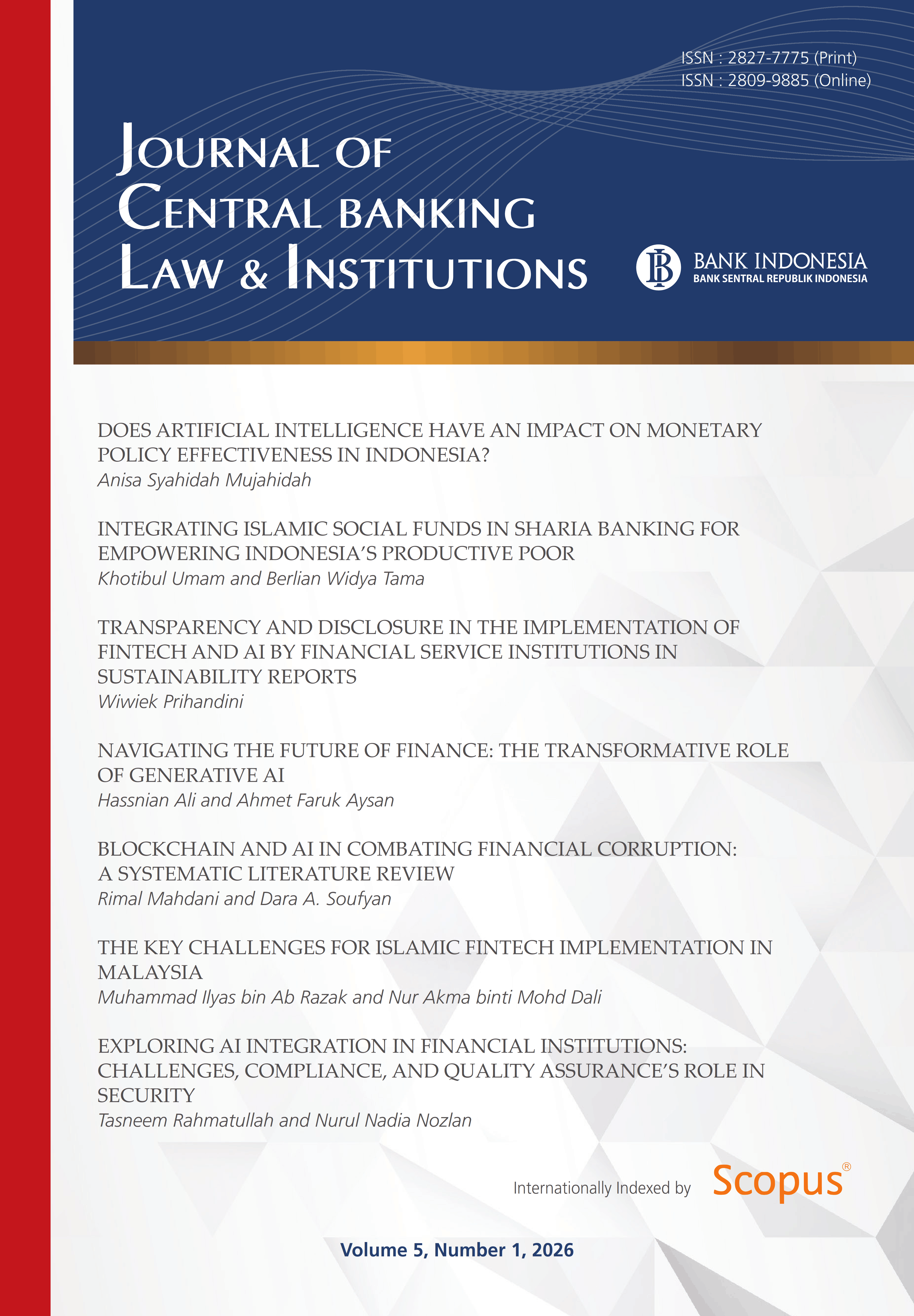
Blockchain and AI in Combating Financial Corruption: A Systematic Literature Review
##plugins.themes.academic_pro.article.sidebar##

Downloads
##plugins.themes.academic_pro.article.main##
Abstract
Corruption in the financial sector threatens economic stability, resource allocation, and public trust. This study explores how blockchain and artificial intelligence (AI) can combat this corruption. Using a systematic literature review (SLR) guided by the PRISMA methodology, we analysed articles from 2020 to 2024. Findings show that blockchain enhances transparency through immutable, decentralised ledgers, while AI improves fraud detection through realtime anomaly detection and predictive analytics. Case studies reveal successful applications, such as greater accountability in public procurement and enhanced fraud detection in banking. However, adoption of these technologies faces challenges, including scalability, regulatory hurdles, and data privacy concerns. Integrating blockchain and AI into financial institutions’ operations can strengthen existing anti-corruption measures, boosting transparency and accountability. Yet, this study is limited by the technologies’ early development stage and the shifting regulatory environment. Future research should address barriers to unlocking the full potential of AI and blockchain to build a more equitable financial system.
##plugins.themes.academic_pro.article.details##
References
- Akhtaruzzaman, Md., S. Rayhan Kabir, Rafita Haque, Muhammad Jafar Sadeq, and Arpita Chowdhury. “A Combined Model of Blockchain, Price Intelligence and IoT for Reducing the Corruption and Poverty.” April 30, 2020, 13–24. https://doi.org/10.17501/23621028.2019.6102.
- Alves Batista, Danielle. “Enhancing Transparency and Accountability in Public Procurement: Exploring Blockchain Technology to Mitigate Records Fraud.” Records Management Journal 34, no. 2/3 (2024): 151–70. https://doi.org/10.1108/RMJ-10-2023-0054.
- Andrade, Guilherme Paulo, Júlio César Andrade De Abreu, and Ruan Carlos Dos Santos. “The Impact of Blockchain on Brazilian Public Procurement Processes from the Perspective of Transaction Costs: Scenarios as Perceived by Experts.” International Journal of Organizational Analysis 33, no. 2 (2025): 365–89. https://doi.org/10.1108/IJOA-07-2023-3829.
- Astuti, Yuniasih Dwi, and Vid Adrison. “The Audit Board of Republic of Indonesia Opinion and Bribery in Local Governments in Indonesia.” Jurnal Tata Kelola Dan Akuntabilitas Keuangan Negara, December 26, 2019, 125–38. https://doi.org/10.28986/jtaken.v5i2.379.
- Azmi, Ilima Fitri, and Alih Aji Nugroho. “Anti-Corruption System 4.0: The Adoption of Blockchain Technology in the Public Sector.” Integritas : Jurnal Antikorupsi 9, no. 1 (June 2023): 93–108. https://doi.org/10.32697/integritas.v9i1.985.
- Bandy, Anita B., Emily A. Reitmeier, Mayra C Suárez, Shirley Diaz, and Flom Llp. The U.S. Government Is Using AI to Detect Potential Wrongdoing, and Companies Should, Too. 04 2024.
- Caruso, Simone, Manfredi Bruccoleri, Astrid Pietrosi, and Antonio Scaccianoce. “Artificial Intelligence to Counteract ‘KPI Overload’ in Business Process Monitoring: The Case of Anti-Corruption in Public Organizations.” Business Process Management Journal 29, no. 4 (2023): 1227–48. https://doi.org/10.1108/BPMJ-11-2022-0578.
- Chouaibi, Yamina, Roua Ardhaoui, and Wajdi Affes. “Does Good Governance Moderate the Relationship between Blockchain Technology Use and Tax Evasion? Evidence from STOXX 600.” EuroMed Journal of Business, ahead of print, June 19, 2024. https://doi.org/10.1108/EMJB-12-2023-0337.
- Cooray, Arusha, and Friedrich Schneider. “Does Corruption Throw Sand into or Grease the Wheels of Financial Sector Development?” Public Choice 177, nos. 1–2 (2018): 111–33. https://doi.org/10.1007/s11127-018-0592-7.
- Costa, Jacopo. “Working Paper 36: Revealing the Networks behind Corruption and Money Laundering Schemes: An Analysis of the Toledo–Odebrecht Case Using Social Network Analysis and Network Ethnography.” Basel Institute on Governance Working Papers, July 1, 2021, 1–35. https://doi.org/10.12685/bigwp.2021.36.1-35.
- Esoimeme, Ehi Eric. “Institutionalising the War against Corruption: New Approaches to Assets Tracing and Recovery.” Journal of Financial Crime 27, no. 1 (2020): 217–30. https://doi.org/10.1108/JFC-12-2018-0125.
- Falwadiya, Himanshu, and Sanjay Dhingra. “Blockchain Technology Adoption in Government Organizations: A Systematic Literature Review.” Journal of Global Operations and Strategic Sourcing 15, no. 3 (2022): 473–501. https://doi.org/10.1108/JGOSS-09-2021-0079.
- Ismunarno, Ismunarno, Hartiwiningsih Hartiwiningsih, and Isharyanto Isharyanto. “Optimization of the Corruption Court in Minimizing State Losses Due to Corruption.” In Proceedings of the International Conference for Democracy and National Resilience 2022 (ICDNR 2022), edited by Gayatri Dyah Suprobowati, Dona Budi Kharisma, and Waluyo Waluyo, 208–17. Paris: Atlantis Press SARL, 2023. https://doi.org/10.2991/978-2-494069-75-6_26.
- Jungo, João, Mara Madaleno, and Anabela Botelho. “Controlling Corruption in African Countries: Innovation, Financial Inclusion and Access to Education as Alternative Measures.” International Journal of Social Economics 50, no. 6 (2023): 766–86. https://doi.org/10.1108/IJSE-08-2022-0520.
- Kenetey, Gifty, and Boris Popesko. “Budgetary Control and the Adoption of Consortium Blockchain Monitoring System in the Ghanaian Local Government.” International Journal of Public Sector Management 38, no. 1 (2025): 12–29. https://doi.org/10.1108/IJPSM-07-2023-0212.
- Lawan, Aliyu Abubakar, and Pekka Henttonen. “Shaping AntiCorruption Strategies: Investigator Perspectives on Electronic Records.” Journal of Financial Crime 32, no. 3 (2025): 558–71. https://doi.org/10.1108/JFC-03-2024-0120.
- Lehner, Othmar Manfred, Kim Ittonen, Hanna Silvola, Eva Ström, and Alena Wührleitner. “Artificial Intelligence Based Decision-Making in Accounting and Auditing: Ethical Challenges and Normative Thinking.” Accounting, Auditing & Accountability Journal 35, no. 9 (2022): 109–35. https://doi.org/10.1108/AAAJ-09-2020-4934.
- Mahdani, Rimal, Hafizhah Risnafitri, and Mardiaton. “Exploring the Potential Applications of Blockchain Technology in Accounting Practice: A Systematic Literature Review.” Jurnal Dinamika Akuntansi dan Bisnis 11, no. 1 (2024): 15–32. https://doi.org/10.24815/jdab.v11i1.33476.
- Mansour, Ala’a Zuhair, Aidi Ahmi, Oluwatoyin Muse Johnson Popoola, and Asma Znaimat. “Discovering the Global Landscape of Fraud Detection Studies: A Bibliometric Review.” Journal of Financial Crime 29, no. 2 (2022): 701–20. https://doi.org/10.1108/JFC-03-2021-0052.
- Mishra, Himani, and Prateek Maheshwari. “Blockchain in Indian Public Distribution System: A Conceptual Framework to Prevent Leakage of the Supplies and Its Enablers and Disablers.” Journal of Global Operations and Strategic Sourcing 14, no. 2 (June 2021): 312–35. https://doi.org/10.1108/JGOSS-07-2020-0044.
- Mohsen, Sara Ebrahim, Allam Hamdan, and Haneen Mohammad Shoaib. “Digital Transformation and Integration of Artificial Intelligence in Financial Institutions.” Journal of Financial Reporting and Accounting 23, no. 2 (2025): 680–99. https://doi.org/10.1108/JFRA-09-2023-0544.
- Mokhomole, Tumiso D. “The Role and Impact of Forensic Investigations Unit in the Fight Against Fraud, Corruption, Irregularities, Financial Misconduct and Maladministration in the Public Sector of South Africa.” Khazanah Hukum 5, no. 1 (2023): 18–32. https://doi.org/10.15575/kh.v5i1.22605.
- Mouna, Amari, Baklouti Nedra, and Mouakher Khaireddine. “International Comparative Evidence of E-Government Success and Economic Growth: Technology Adoption as an Anti-Corruption Tool.” Transforming Government: People, Process and Policy 14, no. 5 (2020): 713–36. https://doi.org/10.1108/TG-03-2020-0040.
- Olubusola Odeyemi, Chinwe Chinazo Okoye, Onyeka Chrisanctus Ofodile, Omotayo Bukola Adeoye, Wilhelmina Afua Addy, and Adeola Olusola Ajayi-Nifise. “Integrating AI with Blockchain for Enhanced Financial Services Security.” Finance & Accounting Research Journal 6, no. 3 (2024): 271–87. https://doi.org/10.51594/farj.v6i3.855.
- Osmani, Mohamad, Ramzi El-Haddadeh, Nitham Hindi, Marijn Janssen, and Vishanth Weerakkody. “Blockchain for next Generation Services in Banking and Finance: Cost, Benefit, Risk and Opportunity Analysis.” Journal of Enterprise Information Management 34, no. 3 (2021): 884–99. https://doi.org/10.1108/JEIM-02-2020-0044.
- Ozelli, Selva. Spain Tackles Corruption with Blockchain AI and Amendments to Its AntiCorruption Laws: Expert Take. June 15, 2018. https://cointelegraph.com/news/spain-tackles-corruption-with-blockchain-ai-and-amendments-toits-anti-corruption-laws-expert-take.
- Padilla, Julio Maturana, Raul Martelo J., and Natividad Villabona. “Estimation of Financial Fraud Present in Industrial and Commercial Companies. International Journal of Engineering and Technology 10, no. 6 (2018): 1548–54. https://doi.org/10.21817/ijet/2018/v10i6/181006208.
- Page, Matthew J., Joanne E. McKenzie, Patrick M. Bossuyt et al. “The PRISMA 2020 Statement: An Updated Guideline for Reporting Systematic Reviews.” BMJ, March 29, 2021, n71. https://doi.org/10.1136/bmj.n71.
- Pal, Abhinav, Chandan Kumar Tiwari, and Aastha Behl. “Blockchain Technology in Financial Services: A Comprehensive Review of the Literature.” Journal of Global Operations and Strategic Sourcing 14, no. 1 (2021): 61–80. https://doi.org/10.1108/JGOSS-07-2020-0039.
- Pollock, Alex, Pauline Campbell, Caroline Struthers, Anneliese Synnot, Jack Nunn, Sophie Hill, Heather Goodare, Jacqui Morris, Chris Watts, and Richard Morley. “Stakeholder Involvement in Systematic Reviews: A Scoping Review.” Systematic Reviews 7, no. 1 (2018): 208. https://doi.org/10.1186/s13643-018-0852-0.
- Roszkowska, Paulina. “Fintech in Financial Reporting and Audit for Fraud Prevention and Safeguarding Equity Investments.” Journal of Accounting & Organizational Change 17, no. 2 (2021): 164–96. https://doi.org/10.1108/JAOC-09-2019-0098.
- Salimitari, Mehrdad, Mohsen Joneidi, and Mainak Chatterjee. “AI Enabled Blockchain: An Outlier-Aware Consensus Protocol for Blockchain-Based IoT Networks.” 2019 IEEE Global Communications Conference (GLOBECOM), IEEE, December 2019, 1–6. https://doi.org/10.1109/GLOBECOM38437.2019.9013824.
- Secinaro, Silvana, Francesca Dal Mas, Valerio Brescia, and Davide Calandra. “Blockchain in the Accounting, Auditing and Accountability Fields: A Bibliometric and Coding Analysis.” Accounting, Auditing & Accountability Journal 35, no. 9 (2022): 168–203. https://doi.org/10.1108/AAAJ-10-2020-4987.
- Serebrennikova, Anna, Tatiana Minyazeva, Denis Dobryakov, Valentina Shiyаn, and Olga Afanasieva. “Countering Corruption in the Context of Digitalisation: Criminal and Criminological Aspects.” Journal of Financial Crime 30, no. 1 (2023): 130–42. https://doi.org/10.1108/JFC-12-2021-0265.
- Setor, Tenace Kwaku, P.K. Senyo, and Atta Addo. “Do Digital Payment Transactions Reduce Corruption? Evidence from Developing Countries.” Telematics and Informatics 60 (2021): 101577. https://doi.org/10.1016/j.tele.2021.101577.
- Shaharuddin, Norhasimah, Mohd Hafiz Abd. Wahab, Nik Rozila Nik Masdek, Norzitah Abdul Karim, Bushra Mohd Zaki, and Salwaty Jamaludin. “Does Financial Development and Corruption Reduce the Level of Income Inequality? Evidence from Malaysia.” Information Management and Business Review 15, no. 3(SI) (2023): 108–16. https://doi.org/10.22610/imbr.v15i3(SI).3463.
- Shinde, Rucha, Shruti Patil, Ketan Kotecha, and Kirti Ruikar. “Blockchain for Securing AI Applications and Open Innovations.” Journal of Open Innovation: Technology, Market, and Complexity 7, no. 3 (2021): 189. https://doi.org/10.3390/joitmc7030189.
- Singh, Charanjit. “Artificial Intelligence and Deep Learning: Considerations for Financial Institutions for Compliance with the Regulatory Burden in the United Kingdom.” Journal of Financial Crime 31, no. 2 (2024): 259–66. https://doi.org/10.1108/JFC-01-2023-0011.
- Singh, Charanjit, and Wangwei Lin. “Can Artificial Intelligence, RegTech and CharityTech Provide Effective Solutions for Anti-Money Laundering and Counter-Terror Financing Initiatives in Charitable Fundraising.” Journal of Money Laundering Control 24, no. 3 (2021): 464–82. https://doi.org/10.1108/JMLC-09-2020-0100.
- Teichmann, Fabian Maximilian Johannes, and Marie-Christin Falker. “Cryptocurrencies and Financial Crime: Solutions from Liechtenstein.” Journal of Money Laundering Control 24, no. 4 (2021): 775–88. https://doi.org/10.1108/JMLC-05-2020-0060.
- Verbeek, Arnold, and Maria Lundqvist. Artificial Intelligence, Blockchain and the Future of Europe: How Disruptive Technologies Create Opportunities for a Green and Digital Economy: Main Report. LU: Publications Office, 2021. https://data.europa.eu/doi/10.2867/126279.
- Wamba-Taguimdje, Serge-Lopez, Samuel Fosso Wamba, Jean Robert Kala Kamdjoug, and Chris Emmanuel Tchatchouang Wanko. “Influence of Artificial Intelligence (AI) on Firm Performance: The Business Value of AI-Based Transformation Projects.” Business Process Management Journal 26, no. 7 (2020): 1893–924. https://doi.org/10.1108/BPMJ-10-2019-0411.

This work is licensed under a Creative Commons Attribution-NonCommercial-ShareAlike 4.0 International License.