
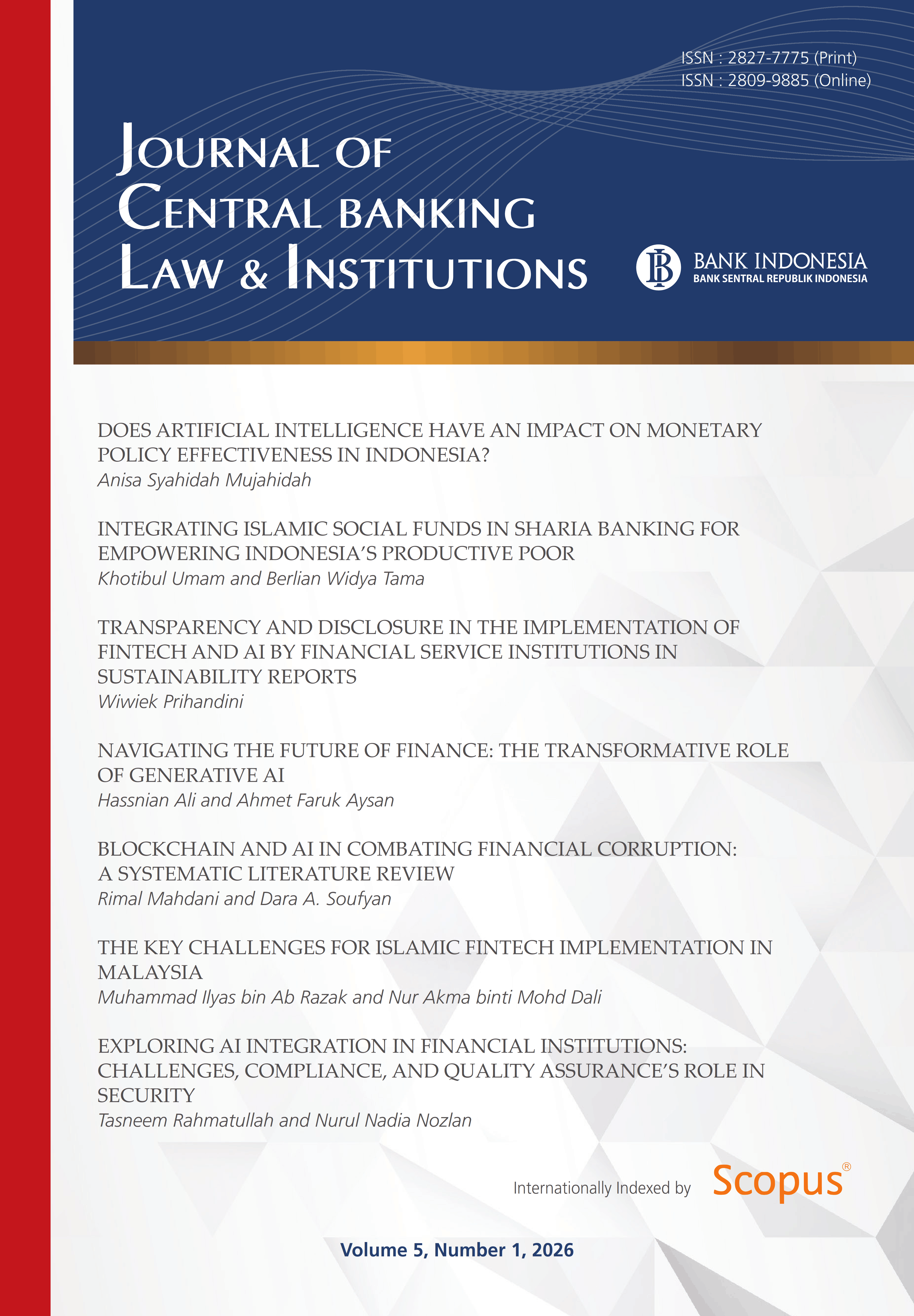
Does Artificial Intelligence Have an Impact on Monetary Policy Effectiveness in Indonesia?
##plugins.themes.academic_pro.article.sidebar##

Downloads
##plugins.themes.academic_pro.article.main##
Abstract
The study empirically investigates the implications of AI Readiness, Broad Money, and political stability for monetary policy effectiveness, as measured by a composite index. The study uses robust fixed-effect panel data estimation techniques to analyse data from 19 OIC member countries between 2019 and 2023, with a focus on Indonesia. The results show that AI readiness and political stability have a substantial positive impact on monetary policy effectiveness in Indonesia, whereas Broad Money has a significant adverse impact. These findings offer relevant policy implications for AI transformation in the financial sector, particularly for effective monetary policy. These findings establish a relationship between the quest for high-quality institutions, defined by the readiness of AI implementation, political stability, and stable broad money. The study adds to a recent body of literature on the impact of AI and other variables on the efficiency of monetary policy.
##plugins.themes.academic_pro.article.details##
References
- Abude, Francis Mawuli, Jones Odei-Mensah, and Eric Schaling. “Developing Artificial Intelligence-Powered Monetary Policy Communication Indicators for Macroeconomic Inquiries in Ghana.” Communicare: Journal for Communication Studies in Africa 43, no. 1 (2024): 14–35. https://doi.org/10.36615/jcsa.v43i1.2779.
- Afnan, Ghanayem, Gareth Downing, and Murad Sawalha. “The Impact of Political Instability on Inflation Volatility: The Case of the Middle East and North Africa Region.” Cogent Economics and Finance 11, no. 1 (2023). https://doi.org/10.1080/23322039.2023.2213016.
- Ahn, Seung C., and Hyungsik Roger Moon. “Large-N and Large-T Properties of Panel Data Estimators and the Hausman Test.” SSRN Electronic Journal, 2005. https://doi.org/10.2139/ssrn.283252.
- Aisen, Ari, and Francisco Jose Veiga. “Does Political Instability Lead to Higher Inflation? A Panel Data Analysis.” Journal of Money, Credit and Banking 38, no. 5 (2006): 1379–89. https://www.jstor.org/stable/3839011.
- AlHarbi, Ahmad, Wafa Sbeiti, and Moid Ahmad. “Money Supply, Banking and Economic Growth: A Cross Country Analysis.” International Journal of Economics and Financial Issues 14, no. 2 (2024): 234–42. https://doi.org/10.32479/ijefi.15749.
- Ali, Mohsin, Urooj Anwar, Mudeer Ahmad Khattak, and Muhammad Umar Islam. “Digitalisation and Economies of OIC Countries.” Bulletin of Monetary Economics and Banking 27, no. 0 (2024): 155-70.
- Ansari, M.I., and S.M. Ahmed. “Does Money Matter? Evidence from Vector Error – Correction for Mexico.” The Journal of Developing Areas 41, no. 1 (2007): 185-202, https://www.jstor.org/stable/40376166.
- Arfanuzzaman, Md. “The Long-Run Dynamic Relationship between Broad Money Supply and the GDP of Bangladesh: A VECM Approach.”Developing Country Studies 4, no. 14 (2014): 167– 79.
- Armantier, Olivier, Gizem Koşar, Rachel Pomerantz, Daphné Skandalis, Kyle Smith, Giorgio Topa, and Wilbert van der Klaauw. “How Economic Crises Affect Inflation Beliefs: Evidence from the Covid-19 Pandemic.” Journal of Economic Behavior and Organisation 189 (2021): 443–69. https://doi.org/10.1016/j.jebo.2021.04.036.
- Ascarya. “Transmission Channel and Effectiveness of Dual Monetary Policy in Indonesia.” Bulletin of Monetary Economics and Banking 14, no. 3 (2012):269-98.
- Bach, Mirjana Pejič, Živko Krstič, Sanja Seljan, and Lejla Turulja. “Text Mining for Big Data Analysis in Financial Sector: A Literature Review.” Sustainability (Switzerland) 11, no. 5 (2019). https://doi.org/10.3390/su11051277.
- Barbaglia, Luca, Sergio Consoli, Sebastiano Manzan, Luca Tiozzo Pezzoli, and Elisa Tosetti. “Sentiment Analysis of Economic Text: A Lexicon-Based Approach.” SSRN Electronic Journal, (2022). https://doi.org/10.2139/ssrn.4106936.
- Burkhart, Ross E, and Michael S. Lewis-Beck. “Comparative Democracy: The Economic Development Thesis.” The American Political Science Review 88, no. 4 (1994): 903–10.
- Campos, Nauro F., Menelaos G. Karanasos, and Bin Tan. “Two to Tangle: Financial Development, Political Instability and Economic Growth in Argentina.” Journal of Banking and Finance 36, no. 1 (2012): 290–304. https://doi.org/10.1016/j.jbankfin.2011.07.011.
- Dundua, Mariam, and Otar Gorgodze. “Application of Artificial Intelligence for Monetary Policy-Making,” National Bank of Georgia Working Papers 2, (2022).
- Ekinci, Ramazan. “The Impact on Digitalisation on Financial Sector Performance.” In The Impact of Artificial Intelligence on Governance, Economics and Finance, Volume I. Edited by S. Bozkuş Kahyaoğlu, Springer, 2021.
- European Central Bank. “Manual on MFI Balance Sheet Statistics.” (2012): 156.
- Fiador, Vera, Emmanuel Sarpong-Kumankoma, and Nana Kwasi Karikari. “Monetary Policy Effectiveness in Africa: The Role of Financial Development and Institutional Quality.” Journal of Financial Regulation and Compliance 30, no. 3 (2022): 335–52. https://doi.org/10.1108/JFRC-03-2021-0024.
- Frees, Edward W. Longitudinal and Panel Data Analysis and Applications in the Social Sciences. Cambridge University Press, 2004.
- Gujarati, Damodar N., and Dawn C. Porter. Basic Econometrics. McGraw-Hill Education, 2009.
- He, Dong, Ross Leckow, Vikram Haksar et al. “Fintech and Financial Services: Initial Considerations.” International Monetary Fund Staff Discussion Notes 5 (2017) 49.
- Hermes, Niels, and Robert Lensink. “Does Financial Liberalisation Influence Saving, Investment and Economic Growth? Evidence from 25 Emerging Market Economies, 1973-96.” In Financial Development, Institutions, Growth and Poverty Reduction. Edited by Basudeb Guha-Khasnobis and George Mavrotas. Springer, 2008. 164-18.
- Hikam, Ahmad Nailul, Taosige Wau, Muhammad Ghafur Wibowo, and Ibnu Muhdir. “Economic Growth in OIC Countries: The Role of Political Stability.” Economics Development Analysis Journal 13, no. 1 (2024): 125–39.
- Hill, R. Carter, William E. Griffiths, and Guay C. Lim. Principles of Econometrics, 3rd Ed. Wiley, 2008.
- Kaur, Kajleen, Yogieta S. Mehra, and Jasmit Kaur. “Effectiveness of Monetary Policy in Controlling Inflation.” Journal of Business Thought 5 (2015): 59-70.
- Koçošlu, Enes, and Filiz Ersöz. “The Application of Data Mining Application with Machine Learning Algorithms to Manage Interest Rate Risk.” Business & Management Studies: An International Journal 10, no. 4 (2022): 1545–64. https://doi.org/10.15295/bmij.v10i4.2162.
- Kurniasari, Wulan, Adi Rahmansyah, Gharas Umara, and Beta Mustika Wati. “Navigating Economic Growth: The Roles of AI Readiness, Trade Openness, Inflation, and Unemployment in ASEAN-7,” Proceedings of the 7th International Conference of Economics, Business, and Entrepreneurship, ICEBE 2024, Malaysia, 2024. https://doi.org/10.4108/eai.4-9-2024.2353717.
- Makarov, O., and S. Arzhevitin. “Coordination of Monetary and Fiscal Policies During Crisis.” Financial and Credit Activity Problems of Theory and Practice 6, no. 41 (2022): 17–31. https://doi.org/10.18371/fcaptp.v6i41.251384.
- Marwaha, Sudeep, Chandan Kumar Deb, Md Ashraful Haque, Sanchita Naha, and Arpan Kumar Maji. “Application of Artificial Intelligence and Machine Learning in Agriculture.” In Translating Physiological Tools to Augment Crop Breeding. Edited by Marwaha, Sudeep, Chandan Kumar Deb, Md Ashraful Haque, Sanchita Naha, and Arpan Kumar Maji, Springer, 2023. 441–57. https://doi.org/10.1007/978-981-19-7498-4_21.
- e Mendonça, Helder Ferreira, and Natalia Cunha Nascimento. “Monetary Policy Efficiency and Macroeconomic Stability: Do Financial Openness and Economic Globalisation Matter?” The North American Journal of Economics and Finance 53, (2020): 1–20. https://doi.org/10.1016/j.najef.2018.10.018.
- de Mendonça, Helder Ferreira, and Igor da Silva Veiga. “A Note on Openness and Inflation Targeting: Implications for the Unpleasant Fiscal Arithmetic.” Macroeconomic Dynamics 18, no. 5 (2014): 1187–1207. https://doi.org/10.1017/S1365100512000752.
- Mishra, Prachi, and Peter Montiel. “How Effective is Monetary Transmission in Low-Income Countries? A Survey of the Empirical Evidence.” IMF Working Papers 12, no. 143 (2012): 1-48. https://doi.org/10.5089/9781475504064.001.
- Mohammed Ershad, Hussain, and Haque Mahfuzul. “Empirical Analysis of the Relationship between Money Supply and Per Capita GDP Growth Rate in Bangladesh.” Journal of Advances in Economics and Finance 2, no. 1 (2017): 54–66. https://doi.org/10.22606/jaef.2017.21005.
- Mojon, Benoit. “Financial Structure and the Interest Rate Channel of ECB Monetary Policy.” European Central Bank Working Papers, no. 40 (2000).
- Murthy, K.V. Bhanu, and Anjala Kalsie. “Measurement of International Currency Crises: A Panel Data Approach Using Composite Indices.” Vikalpa 38, no. 4 (2013): 13–36. https://doi.org/10.1177/0256090920130402.
- Naghdaliyev, Namig. “Central Banks’ Communication in the Post-Crisis Period,” SSRN Electronic Journal (2011): 1–29.
- Noble, Nwanhele, and Aguwamba Rowland Chidi. “Artificial Intelligence Solutions for Economic Resilience: Addressing Inflation, Food Scarcity, and Insecurity in Nigeria.” Paper presented at the Academic Staff Union of Polytechnics 1st International Hybrid Conference at ASUP Solidarity Complex, Federal Polytechnic, Nekede, June 18-21, 2024.
- Piduru, Bhargav Reddy. “Navigating Digital Transformation: Impacts on Inflation and the Job Market.” International Journal of Engineering and Technology Research (IJETR) 8, no. 1 (2023): 1-10.
- Potrafke, Niklas. “The Evidence on Globalisation.” World Economy 38, no. 3 (2015): 509–52. https://doi.org/10.1111/twec.12174.
- Rashid, Abdul, and Zainab Jehan. “The Response of Macroeconomic Aggregates to Monetary Policy Shocks in Pakistan.” Journal of Financial Economic Policy 6, no. 4 (2014): 314–30. https://doi.org/10.1108/JFEP-04-2013-0016.
- Wang, Haoyu. “Transformation of Monetary Policy Transmission Mechanisms in the Digital Economy Era.” Modern Economy 15, no. 12 (2024). 1254–64. https://doi.org/10.4236/me.2024.1512065.
- Warhush, Chris, and Wil Hunt. “The Digitalisation of Future Work and Employment: Possible Impact and Policy Responses.” JRC Working Papers Series on Labour, Education and Technology 05 (2019): 57–73. https://hdl.handle.net/10419/205265.
- Wooldridge, Jeffrey M. Introductory Econometrics: A Modern Approach. SouthWestern, 1999.

This work is licensed under a Creative Commons Attribution-NonCommercial-ShareAlike 4.0 International License.