
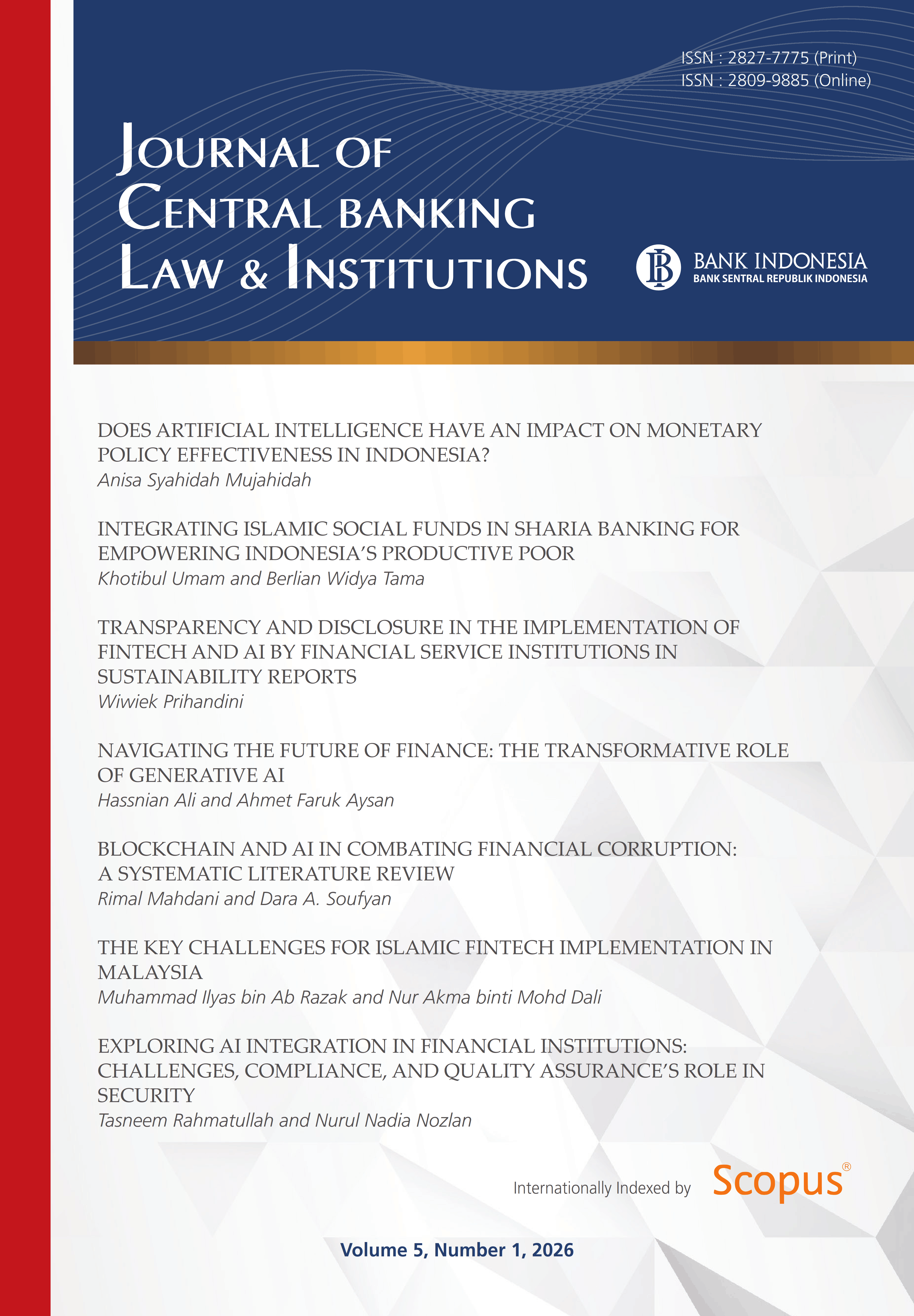
Transparency and Disclosure in the Implementation of Fintech and AI by Financial Service Institutions in Sustainability Reports
##plugins.themes.academic_pro.article.sidebar##

Downloads
##plugins.themes.academic_pro.article.main##
Abstract
This study evaluates the application of financial technology (FinTech) and artificial intelligence (AI), as well as the transparency of their disclosure in Sustainability Reports across four types of financial service institutions (FSIs) in Indonesia: banks, insurance companies, finance companies, and securities firms. By analysing the content of 20 Sustainability Reports, this study finds that banks have the highest level of technology implementation and disclosure, followed by finance, insurance, and securities firms. Although FinTech and AI contribute to operational efficiency, service innovation, and the expansion of financial access, disclosures related to these technologies are still limited in Sustainability Reports, often using terms like “digitalisation” without explicit explanation. These findings underscore the importance of enhanced transparency in technology disclosure to foster public trust and accountability, as well as to ensure compliance with regulations such as the OJK Regulation on Sustainable Finance. This study recommends strengthening reporting standards and regulatory guidelines to improve technology disclosures in the financial sector, thus enabling a sustainable and
inclusive digital financial ecosystem.
##plugins.themes.academic_pro.article.details##
References
- Accenture. Building Trust into Conversational AI Solutions. (Accenture, 2022),
- Aldasaro, Iñaki, Leonardo Gambacorta, Anton Korinek, Vatsala Shreeti, and Merlin Stein. Intelligent Financial System: How AI is Transforming Finance. BIS Working Papers No 1194, 2024.
- Bank Indonesia. Blueprint Sistem Pembayaran Indonesia 2025. Bank Indonesia, 2024.
- Barocas, Solon, and Andrew D. Selbst. “Big Data’s Disparate Impact.” California Law Review 104 no. 3 (2016): 671-732. http://dx.doi.org/10.15779/Z38BG31.
- Bonsón, Enrique, and Michaela Bednárová. “Artificial Intelligence Disclosures in Sustainability Reports: Towards an Artificial Intelligence Reporting Framework” in Digital Transformation in Industry. Edited by Vikas Kumar, Jiewu Leng, Victoria Akberdina, and Evgeny Kuzmin. Cham: Springer 2022. https://doi.org/10.1007/978-3-030-94617-3.
- Buckley, Ross P., Douglas W. Arner, and Dirk A. Zetzsche. FinTech - Finance, Technology and Regulation. Cambridge University Press. 2024. DOI: https://doi.org/10.1017/9781009086943.
- Chesterman, Simon. From Ethics to Law: Why, When, and How to Regulate AI. Singapore. NUS Law Working Paper no. 2023/014, 2023.
- Corazza, Marco, Rene Garcia, Faisal Shah Khan, Davide La Torre, and Hatem Masri, eds. Artificial Intelligence and Beyond for Finance. World Scientific Publishing Europe, Ltd., 2024.
- Crisanto, Juan C. Cris Benson Leuterio, Jermy Prenio, and Jeffery YongRegulating AI in the Financial Sector: Recent Developments and Main ChallengesFSI Insights on Policy Implementation no 63, 2024.
- Dalton, Gary. Artificial Intelligence: Background, Risks and Policies. Nova Science Publishers, Inc., 2024.
- Endress, Tobias. Digital Project Practice for Banking and FinTech. CRC Press, 2024.
- Financial Stability Board. The Financial Stability Implications of Artificial Intelligence FSB, 2024,
- Floridi, Luciano, ed. Ethics, Governance, and Policies in Artificial Intelligence. Springer, 2021. https://doi.org/10.1007/978-3-030-81907-1.
- Gao, Qiqi, and Jiteng Zhang. Artificial Intelligence Governance and the Blockchain Revolution. Springer, 2024. https://doi.org/10.1007/978-981-99-9211-9.
- Global Reporting Initiative. GRI 2: General Disclosures 2021. GRI, 2025.
- Kaplan, Andreas, and Michael Haenlein. “Siri, Siri, in My Hand: Who’s the Fairest in the Land? On the Interpretations, Illustrations, and Implications of Artificial Intelligence.” Business Horizons 63, no. 1 (2020): 15-25. https://doi.org/10.1016/j.bushor.2018.08.004.
- Krippendorff, Klaus. Contents Analysis: An Introduction and Its Methodology. Sage Publications Inc., 2004.
- Lessambo, Felix I. Fintech Regulation and Supervision Challenges within the Banking Industry, A Comparative Study within the G-20. Cham: Springer, 2023. https://doi.org/10.1007/978-3-031-25428-4.
- Luger, George F. Artificial Intelligence: Principles and Practice. Springer, 2025. https://doi.org/10.1007/978-3-031-57437-5.
- Lui, Alison, and Nicholas Ryder, eds. Fintech, Artificial Intelligence and the Law. Routledge. 2021.
- Mazzi, Francesca, and Luciano Floridi, eds. The Ethics of Artificial Intelligence for the Sustainable Development Goals. Cham: Springer, 2023.
- OECD. Generative Artificial Intelligence in Finance. OECD Publishing, 2023.
- Otoritas Jasa Keuangan. Panduan Kode Etik Kecerdasan Buatan (Artificial Intelligent) yang Bertanggungjawab dan Terpercaya di Industri Teknologi Finansial. OJK, 2023.
- Otoritas Jasa Keuangan. SE OJK No. 51/SEOJK.03/2017 Tentang Penerapan Keuangan Berkelanjutan bagi Lembaga Jasa Keuangan, Emitten, dan Perusahaan Publik. 2017.
- Rajput, Namita, Vikas Garg, Jasmeet Kaur, Jyotsna Oswal. “Global Adoption of Fintech.” In Revolutionary Challenges and Opportunities of Fintech. Edited by Shweta Anand, Shalini Srivastav, Vikas Garg, and Geetika Garg. Apple Academic Press Inc., 2024.
- Ranković, Marko, Elema Gurgu, Oliva M.D. Martins, and Milan Vukasović. “Artificial Intelligence and the Evolution of Finance: Opportunities, Challenges, and Ethical Considerations,” EdTech Journal, 2023: 20-24. https://doi.org/10.18485/edtech.2023.3.1.2.
- Ridzuan, Nurhadhinah Nadiah, Masairol Masri, Muhammad Anshari, Norma Latif Fitriyani, and Muhammad Syafrudin. “AI in the Financial Sector: The Line between Innovation, Regulation and Ethical Responsibility.” Information 15, no. 432, 2024. https://doi.org/10.3390/info15080432.
- Saunders, Anthony, Marcia M. Cornett, Otgo Erhemjamts. Financial Institutions Management: A Risk Management Approach. McGraw Hill, 2024.
- Shiyyab, Fadi Shehab, Abdallah Bader Alzoubi, Qais Mohammad Obidat, and Hashem Alshurafat. “The Impact of Artificial Intelligence Disclosure on Financial Performance.” International Journal of Financial Studies 11, no. 115 (2023). https://doi.org/10.3390/ijfs11030115.
- Sipola, Tuomo, Tero Kokkonen, and Mika Karjalainen, eds. Artificial Intelligence and Cybersecurity: Theory and Applications. Springer, 2023. https://doi.org/10.1007/978-3-031-15030-2
- Soldatos, John, Kyriazis, Dimsothenis. Big Data and Artificial Intelligence in Digital Finance – Increasing Personalization and Trust in Digital Finance using Big Data and AI. Springer, 2022. https://doi.org/10.1007/978-3-030-94590-9.
- Svetlova, Ekaterina. “AI ethics and systemic risks in finance.” AI and Ethics 2 (2020): 713–725. https://doi.org/10.1007/s43681-021-00129-1.
- Visvizi, Anna, and Marek Bodziany, eds. Artificial Intelligence and Its Contexts: Security, Business and Governance. Springer, 2021. https://doi.org/10.1007/978-3-030-88972-2.
- Walker, Thomas, Elaheh Nikbakht, and Maher Kooli, eds. The Fintech Disruption: How Financial Innovation Is Transforming the Banking Industry. Palgrave Macmillan, 2024. https://doi.org/10.1007/978-3-031-23069-1.
- Wiesmüller, Sabine. The Relational Governance of Artificial Intelligence: Forms and Interactions. Springer, 2023. https://doi.org/10.1007/978-3-031-25023-1.
- Zaralli, Mateo. Virtual Reality and Artificial Intelligence: Risks and Opportunities for Your Business. Routledge, 2024.
- Zekos, Georgios I. Political, Economic and Legal Effects of Artificial Intelligence: Governance, Digital Economy and Society. Springer, 2022. https://doi.org/10.1007/978-3-030-94736-1.
- Zwitter, Andrej, and Oskar J. Gstrein. Handbook on the Politics and Governance of Big Data and Artificial Intelligence. Edward Elgar Publishing, 2023. http://dx.doi.org/10.4337/ 9781800887374.

This work is licensed under a Creative Commons Attribution-NonCommercial-ShareAlike 4.0 International License.