
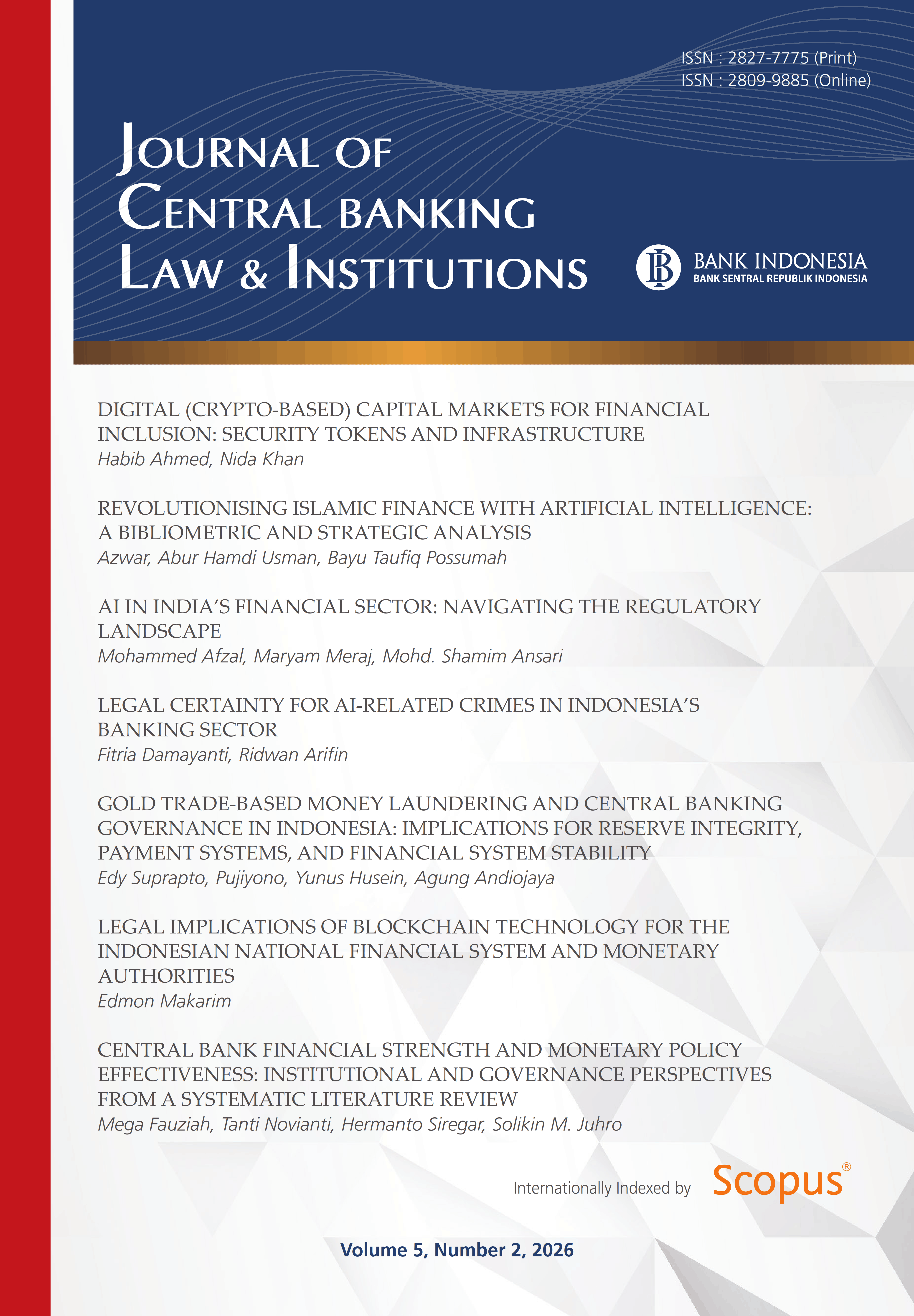
AI in India’s Financial Sector: Navigating the Regulatory Landscape
##plugins.themes.academic_pro.article.sidebar##

Downloads
##plugins.themes.academic_pro.article.main##
Abstract
Artificial Intelligence (AI) integration in India’s financial sector offers transformative potential but poses challenges like algorithmic bias, data privacy risks, and regulatory fragmentation. This study employed both one-on-one interviews and surveys with various stakeholders in the financial services sector to analyse India’s AI governance framework through expert interviews and a comparative policy analysis of global models (the EU’s risk-based AI Act and the US sector-specific guidelines). Findings reveal gaps in accountability, transparency, and enforcement mechanisms, particularly for high-risk applications like credit scoring. This study proposes a hybrid regulatory model that combines binding rules for high-risk AI systems (e.g., fraud detection) with co-regulation for low-risk tools, emphasising scientific risk assessment, consumer grievance mechanisms, and iterative policymaking. While leveraging India’s existing financial laws (e.g., Reserve Bank of India guidelines), we recommend AI-specific updates to address explainability, bias audits, and systemic risk monitoring. However, this study is limited by its reliance on publicly available regulatory documents and expert interviews, and by its focus on the Indian context, which may overlook cross-border AI governance challenges. Stakeholder collaboration and phased implementation are critical to balancing innovation with ethical safeguards in India’s evolving digital economy.
##plugins.themes.academic_pro.article.details##
References
- Aldboush, Hassan H.H., and Marah Ferdous. “Building Trust in Fintech: An Analysis of Ethical and Privacy Considerations in the Intersection of Big Data, AI, and Customer Trust.” International Journal of Financial Studies 11, no. 3 (2023): 90. https://doi.org/10.3390/ijfs11030090.
- Bal, Ravtosh, and Indermit S. Gill. “Policy Approaches to Artificial Intelligence Based Technologies in China, European Union, and the United States.” Duke Global Working Paper Series No. 26, Duke University, 2020. https://doi.org/10.2139/ssrn.3699640.
- Bengio, Yoshua, Sören Mindermann, Daniel Privitera, et al. “International AI Safety Report 2025.” Department for Science, Innovation and Technology (DSIT). January 19, 2025. https://internationalaisafetyreport.org/publication/international-ai-safety-report-2025.
- Biden, Joseph R. “Executive Order 14110: Safe, Secure, and Trustworthy Development and Use of Artificial Intelligence.” October 30, 2023. Federal Register 88 (November 1, 2023): 75191. https://www.federalregister.gov/documents/2023/11/01/2023-24283/safe-secure-and-trustworthydevelopment-and-use-of-artificial-intelligence.
- Biju, P. R., and O. Gayathri. “The Indian Approach to Artificial Intelligence: An Analysis of Policy Discussions, Constitutional Values, and Regulation.” AI & Society 39, no. 5 (2024): 2321-2335. https://doi.org/10.1007/s00146-023-01685-2.
- Biswas, Suparna, Brant Carson, Violet Chung, Shwaitang Singh, and Renny Thomas. “AI-Bank of the Future: Can Banks Meet the AI Challenge?” New York: McKinsey & Company, September 22, 2020. https://www.mckinsey.com/industries/financial-services/our-insights/ai-bank-of-the-futurecan-banks-meet-the-ai-challenge#/.
- Boukherouaa, El Bachir, Ghiath Shabsingh, Khaled Al-Ajmi, et al. Powering the Digital Economy: Opportunities and Risks of Artificial Intelligence in Finance, International Monetary Fund, 2021. https://www.imf.org/en/publications/departmental-papers-policy-papers/issues/2021/10/21/powering-the-digital-economy-opportunities-and-risks-of-artificialintelligence-in-finance-494717.
- Chen, Xun-Qi, Chao-Qun Ma, Yi-Shuai Ren, Yu-Tian Lei, Ngoc Quang Anh Huynh, and Seema Narayan. “Explainable Artificial Intelligence in Finance: A Bibliometric Review.” Finance Research Letters 56 (2023): 104145. https://doi.org/10.1016/j.frl.2023.104145.
- Doelker, Andreas. “Self-Regulation and Co-Regulation: Prospects and Boundaries in an Online Environment.” PhD diss., University of British Columbia, 2010. https://open.library.ubc.ca/soa/cIRcle/collections/ubctheses/24/items/1.0071207.
- Dwivedi, Yogesh K., Nir Kshetri, Laurie Hughes, et al. “Opinion Paper: “So What If ChatGPT Wrote It?” Multidisciplinary Perspectives on Opportunities, Challenges and Implications of Generative Conversational AI for Research, Practice and Policy.” International Journal of Information Management 71 (2023): 102642. https://doi.org/10.1016/j.ijinfomgt.2023.102642.
- The General Data Protection Regulation 2016/279 (European Union), 2018.
- Graham, Webster, Rogier Creemers, Elsa Kania, and Paul Triolo, “China’s ‘New Generation Artificial Intelligence Development Plan’ (2017),” DigiChina, August 1, 2017, https://digichina.stanford.edu/work/full-translationchinas-new-generation-artificial-intelligence-development-plan-2017/.
- Hacker, Philipp. “The European AI Liability Directives–Critique of a Half-Hearted Approach and Lessons for the Future.” Computer Law & Security Review 51 (2023): 105871. https://doi.org/10.1016/j.clsr.2023.105871.
- India. The Information Technology Act, 2000.
- India. The Payment and Settlement Systems Act, 2007.
- India. The Digital Personal Data Protection Bill, 2022.
- Jabłonowska, Agnieszka, Maciej Kuziemski, Anna Maria Nowak, Hans-W. Micklitz, Przemysław Pałka, and Giovanni Sartor. “Consumer Law and Artificial Intelligence: Challenges to the EU Consumer Law and Policy Stemming from the Business’ Use of Artificial Intelligence - Final Report of the ARTSY Project.” EUI Department of Law Research Paper No. 2018/11, European University Institute, 2018. https://doi.org/10.2139/ssrn.3228051.
- Judge, Richard, Bartlett Judge, and Shirin Elahi. “Regulating for Resilience.” National Preparedness Commission, September 6, 2024. https://nationalpreparednesscommission.uk/publications/regulating-forresilience/.
- Kapoor, Rahul. “AI Regulation in India: Current State and Future Perspectives.” Morgan Lewis.com, January 26, 2024. https://www.morganlewis.com/blogs/sourcingatmorganlewis/2024/01/ai-regulation-in-india-currentstate-and-future-perspectives.
- Kile, Frederick. “Artificial Intelligence and Society: A Furtive Transformation.” AI & society 28, no. 1 (2013): 107-115. https://doi.org/10.1007/s00146-012-0396-0.
- Lancieri, Filippo, Laura Edelson, and Stefan Bechtold. “AI Regulation: Competition, Arbitrage and Regulatory Capture.” Theoretical Inquiries in Law 26, no. 1 (2025): 239-262. https://doi.org/10.1515/til-2025-0010.
- Lee, Joseph. “Access to Finance for Artificial Intelligence Regulation in the Financial Services Industry.” European Business Organization Law Review 21, no. 4 (2020): 731-757.
- Mazurek, Grzegorz, and Karolina Małagocka. “Perception of Privacy and Data Protection in the Context of the Development of Artificial Intelligence.” Journal of Management Analytics 6, no. 4 (2019): 344-364. https://doi.org/10.1080/23270012.2019.1671243.
- Ministry of Information Technology, “Intermediary Guidelines and Digital Media Ethics Code,” 2021, Updated April 6, 2023. https://www.ascionline.in/wpcontent/uploads/2022/11/asci_code_of_self_regulation.pdf.
- MIT AI Risk Repository. “What Are the Risks from Artificial Intelligence?”2025. https://airisk.mit.edu/.
- Moberg, Johanna, and Alexis Olevall. “Artificial Intelligence within Financial Services-In Relation to Data Privacy Regulation.” Master’s Thesis, University of Gothenburg, 2018. https://gupea.ub.gu.se/server/api/core/bitstreams/9a03c2eb-b3b2-4775-916a-5e23b9073dca/content.
- Mohanty, Amlan, and Shatakratu Sahu, “India’s Advance on AI Regulation,” Carnegie Endowment for International Peace, November 21, 2024, https://carnegieendowment.org/research/2024/11/indias-advance-onai-regulation?lang=en¢er=india.
- NITI Aayog, Principles for Responsible AI: Approach Document for India (Part 1) (New Delhi: NITI Aayog, February 2, 2021), accessed July 30, 2025, https://www.niti.gov.in/sites/default/files/2021-02/ResponsibleAI-22022021.pdf.
- NITI Aayog, Principles for Responsible AI: Approach Document for India: (Part 2) – (New Delhi: NITI Aayog, February 2, 2021), accessed July 30, 2025, https://www.niti.gov.in/sites/default/files/2021-08/Part2Responsible-AI-12082021.pdf
- Nizioł, Krystyna. “The Challenges of Consumer Protection Law Connected with the Development of Artificial Intelligence on the Example of Financial Services (Chosen Legal Aspects).” Procedia Computer Science 192 (2021): 4103-4111. https://doi.org/10.1016/j.procs.2021.09.185.
- Prasad, Kislaya. “Regulating AI: The Corporate Innovation vs. Consumer Protection Tradeoff.” SSRN (2024). https://doi.org/10.2139/ssrn.4726374.
- Qadiri, Roheed Mehmood, Nairah Shabir, and Monisa Qadri. “Conceptualizing Possibilities of Artificial Intelligence in Furtherance of the Banking Sector: An Effective Tool for Improving Customer Relationship, Customer Service and Public Relations.” International Journal of Finance Insurance and Risk Management 10, no. 2 (2020): 44-65. https://doi.org/10.35808/ijfirm/214.
- “Responsible AI, #AIForAll, Approach Document for India: Part 2 – Operationalizing Principles for Responsible AI.” NITI Aayog, Government of India, August 2021. https://www.niti.gov.in/sites/default/files/2021-08/Part2-Responsible-AI-12082021.pdf
- Ridzuan, Nurhadhinah Nadiah, Masairol Masri, Muhammad Anshari, Norma Latif Fitriyani, and Muhammad Syafrudin. “AI in the Financial Sector: The Line between Innovation, Regulation and Ethical Responsibility.” Information 15, no. 8 (2024): 432. https://doi.org/10.3390/info15080432.
- Rudin, Cynthia, and Joanna Radin, “Why Are We Using Black Box Models in AI When We Don’t Need To? A Lesson from an Explainable AI Competition,” Harvard Data Science Review 1, no. 2 (2019), https://doi.org/10.1162/99608f92.5a8a3a3d.
- Shukla, Upendra Nath, and Anil Dubey. “Expectations of FinTech Start-Ups and Regulatory Sandbox in India: An Empirical Study.” International Journal of Business Innovation and Research 27, no. 2 (2022): 242-262. https://doi.org/10.1504/IJBIR.2022.121542.
- Smuha, Nathalie A. “From a ‘Race to AI’ to a ‘Race to AI Regulation’: Regulatory Competition for Artificial Intelligence.” Law, Innovation and Technology 13, no. 1 (2021): 57-84. https://doi.org/10.1080/17579961.2021.1898300.
- Stepenko, Valery, Lyudmila Dreval, Sergei Chernov, and Viktor Shestak. “EU Personal Data Protection Standards and Regulatory Framework.” Journal of Applied Security Research 17, no. 2 (2022): 190-207. https://doi.org/10.1080/19361610.2020.1868928.
- Swaminathan, Nandhini, and David Danks. “Application of the NIST AI Risk Management Framework to Surveillance Technology.” arXiv preprintarXiv:2403.15646 (2024). https://doi.org/10.48550/arXiv.2403.15646.
- Tartaro, Alessio, Adam Leon Smith, and Patricia Shaw. “Assessing the Impact of Regulations and Standards on Innovation in the Field of AI.” arXiv:2302.04110 (2023). https://doi.org/10.48550/arXiv.2302.04110.
- “The code for Self-Regulation of Advertising Content in India,” Advertising Standards Council of India, June 2022 edition. https://www.ascionline.in/wp-content/uploads/guidelines/ASCI_Codes_Guidelines_Book.pdf
- “The Digital Services Act: Practical Implications for Online Services and Platforms.” Latham & Watkins. March 2023. https://www.lw.com/admin/upload/SiteAttachments/Digital-Services-Act-Practical-Implications-for-OnlineServices-and-Platforms.pdf.
- “Unchecked Use of AI in Banking Poses Risk: RBI Governor Shaktikanta Das,” The Times of India, October 15, 2024, https://timesofindia.indiatimes.com/business/india-business/unchecked-use-of-aiin-bankingposes-risk-rbi-governor-shaktikanta-das/articleshow/114227753.cms.
- Vermeer, Michael, J. D. Historical Analogues That Can Inform AI Governance. RAND Corporation, 2024, www.rand.org/t/RRA3408-1.
- Vesnic-Alujevic, Lucia, Susana Nascimento, and Alexandre Pólvora. “Societal and Ethical Impacts of Artificial Intelligence: Critical Notes on European Policy Frameworks.” Telecommunications Policy 44, no. 6 (2020): 101961. https://doi.org/10.1016/j.telpol.2020.101961.
- Wang, Weiyu, and Keng Siau. “Artificial Intelligence: A Study on Governance, Policies, and Regulations.” In Proceedings of the Thirteenth Annual MidwestAssociation for Information Systems Conference (MWAIS 2018), St. Louis, Missouri, (2018): 1, https://aisel.aisnet.org/mwais2018/40.
- Wang, Xukang, and Ying Cheng Wu. “Balancing Innovation and Regulation in the Age of Generative Artificial Intelligence.” Journal of Information Policy 14 (2024). https://doi.org/10.5325/jinfopoli.14.2024.0012.
- Xu, Jian, Terence Lee, and Gerard Goggin. “AI Governance in Asia: Policies, Praxis and Approaches.” Communication Research and Practice 10, no. 3 (2024): 275-287. https://doi.org/10.1080/22041451.2024.2391204.
- Yanamala, Anil Kumar Yadav, Srikanth Suryadevara, and Venkata Dinesh Reddy Kalli. “Balancing Innovation and Privacy: The Intersection of Data Protection and Artificial Intelligence.” International Journal of Machine Learning Research in Cybersecurity and Artificial Intelligence 13, no. 1 (2022): 1-43. http://ijmlrcai.com/index.php/Journal/article/view/23.

This work is licensed under a Creative Commons Attribution-NonCommercial-ShareAlike 4.0 International License.