
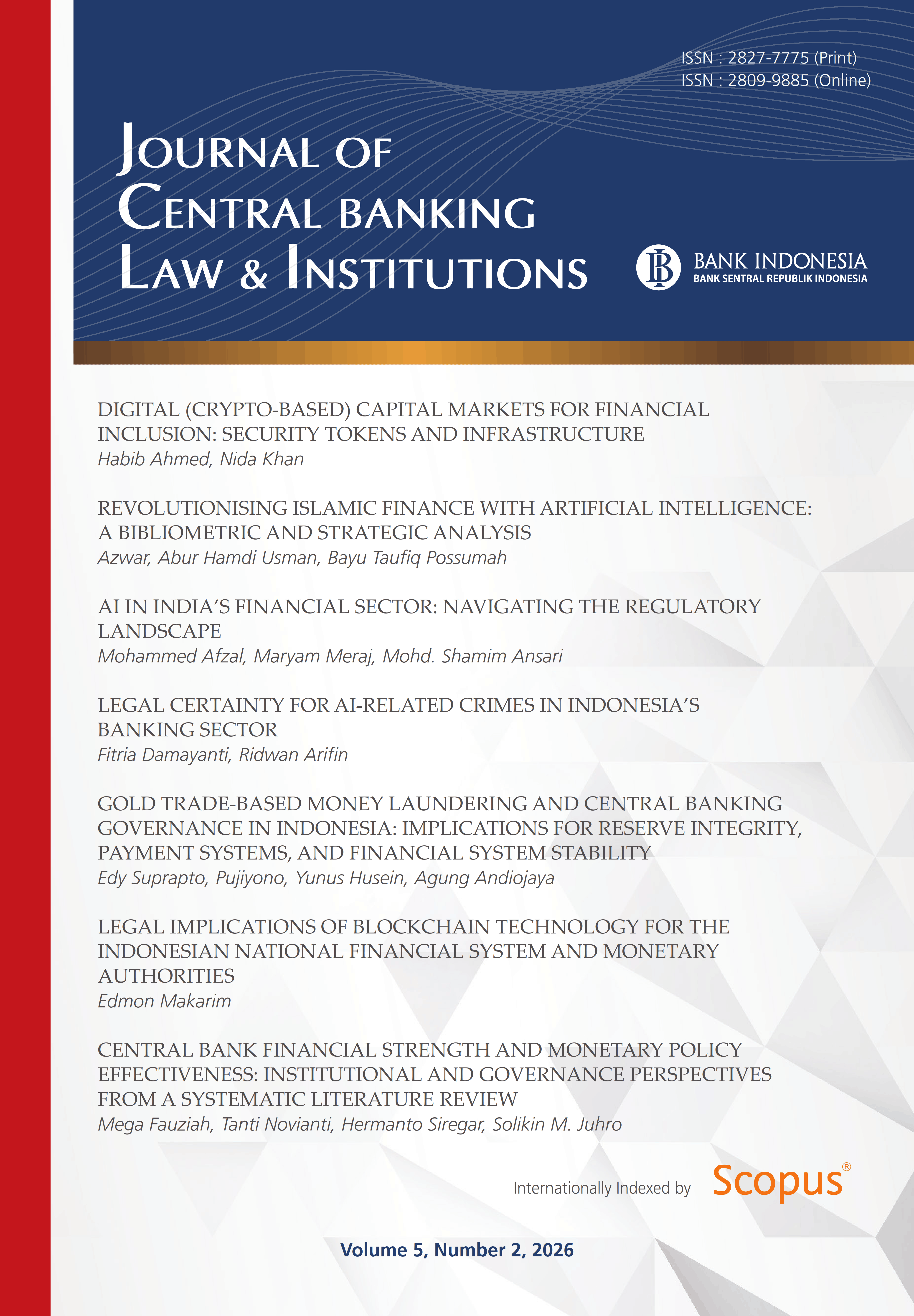
Central Bank Financial Strength and Monetary Policy Effectiveness: Institutional and Governance Perspectives from a Systematic Literature Review
##plugins.themes.academic_pro.article.sidebar##

Downloads
##plugins.themes.academic_pro.article.main##
Abstract
The study offers an interpretation of how central bank financial strength is constructed through legal and governance frameworks by systematically reviewing 17 scholarly articles. Based on the findings of this systematic literature review, it is evident that central bank financial strength is influenced by various legal frameworks, such as capitalisation rules, loss-absorption rules, surplus distribution rules, and a legal framework that outlines the relationship between monetary and fiscal authorities. The findings suggest that insufficient Central Bank Financial Strength (CBFS) can lead to governance issues, such as greater fiscal dependence and reduced protection against political interference. The review identifies important institutional and legal implications. The study concludes that it is crucial to strengthen capital adequacy rules, ensure transparent reporting, establish independent oversight, and have clear procedures for recapitalisation. From this perspective, it is evident that CBFS is part of the legal framework of central banking and offers a design-based platform through which central banking authorities can build and maintain credibility.
##plugins.themes.academic_pro.article.details##
References
- Adler, Gustavo, Pedro Castro, and Camilo E. Tovar. “Does Central Bank Capital Matter for Monetary Policy?” Open Economies Review 27, no. 1 (2016): 183–205. https://doi.org/10.1007/s11079-015-9360-1.
- Arnone, Mario, Bernard J. Laurens, and Jean-François Segalotto. “The Measurement of Central Bank Autonomy: Survey of Models, Indicators, and Empirical Evidence.” IMF Working Paper No. WP/06/227. Washington, DC: International Monetary Fund, 2006. https://doi.org/10.5089/9781451864878.001.
- Blinder, Alan S. “Central-Bank Credibility: Why Do We Care? How Do We Build It?” American Economic Review 90, no. 5 (2000): 1421–31. https://doi.org/10.1257/aer.90.5.1421.
- Bossu, Wouter, and Arthur Rossi. “The Role of Board Oversight in Central Bank Governance: Key Legal Design Issues.” IMF Working Paper No. WP/19/293. International Monetary Fund, 2019. https://doi.org/10.5089/9781513524054.001.
- Buiter, Willem H. “Can Central Banks Go Broke?” CEPR Policy Insight no. 24. London: Centre for Economic Policy Research, 2008. https://ssrn.com/abstract=2489665.
- Chansriniyom, Thitipat, Natan Epstein, and Valeriu Nalban. “The Monetary Policy Credibility Channel and the Amplification Effects in a Semi-Structural Model.” IMF Working Paper No. WP/20/201. International Monetary Fund, 2020. https://doi.org/10.5089/9781513557717.001.
- Conti-Brown, Peter, and Rosa Maria Lastra, eds. Research Handbook on Central Banking. Cheltenham, UK: Edward Elgar Publishing, 2017.
- Cukierman, Alex. “Central Bank Independence and Monetary Policymaking Institutions—Past, Present, and Future.” European Journal of Political Economy 24, no. 4 (2008): 722–736. https://doi.org/10.1016/j.ejpoleco.2008.07.007,
- Cukierman, Alex, Steven B. Webb, and Bilin Neyapti. “Measuring the Independence of Central Banks and Its Effect on Policy Outcomes.” The World Bank Economic Review 6, no. 3 (1992): 353–398. https://doi.org/10.1093/wber/6.3.353.
- Debelle, Guy, and Stanley Fischer. “How Independent Should a Central Bank Be?” In Goals, Guidelines, and Constraints Facing Monetary Policymakers, 195–221. Federal Reserve Bank of Boston, 1994. https://EconPapers.repec.org/RePEc:fip:fedfap:94-05.
- de Mendonça, Helder Ferreira, and Gustavo José de Guimarães e Souza. “Inflation Targeting Credibility and Reputation: The Consequences for the Interest Rate.” Economic Modelling 26, no 6 (2009):1228–1238.
- Eijffinger, Sylvester C. W., and Jakob de Haan. “The Political Economy of Central-Bank Independence.” Special Papers in International Economics No. 19. Princeton University, 1996. https://ies.princeton.edu/pdf/SP19.pdf.
- Filardo, Andrew, Hans Genberg, and Boris Hofmann. “Monetary Analysis and the Global Financial Cycle: An Asian Central Bank Perspective.” Journal of Asian Economics 46 (2016): 1–16. https://doi.org/10.1016/j.asieco.2016.08.002.
- Financial Stability Board. “Central Bank Transparency Code (CBT).” July 2, 2020. https://www.fsb.org/2020/07/central-bank-transparency-code-cbt/.
- Garriga, Ana Carolina, and Carlos M. Rodriguez. “Central Bank Independence and Inflation Volatility in Developing Countries.” Economic Analysis and Policy 78 (2023): 1320–41. https://doi.org/10.1016/j.eap.2023.05.008.
- Goncharov, Igor, Vasso Ioannidou, and Martin C. Schmalz. “Why Do Central Banks Care about Their Profits?” Journal of Finance 78, no. 5 (2023): 2991– 3045. https://doi.org/10.1111/jofi.13257.
- Grilli, Vittorio, Donato Masciandaro, and Guido Tabellini. “Political and Monetary Institutions and Public Financial Policies in the Industrial Countries.” Economic Policy 6, no. 13 (1991): 341–92. https://doi.org/10.2307/1344630.
- Gyeke-Dako, Agyapomaa, Elikplimi Komla Agbloyor, Abel Mawuko Agoba, Festus Turkson, and Emmanuel Abbey. “Central Bank Independence Inflation, and Poverty in Africa.”
- Journal of Emerging Market Finance 21, no. 2 (2022): 211–36. https://doi.org/10.1177/09726527221078434.
- Harmanta, Harmanta, M. Barik Bathaluddin, and Jati Waluyo. “Inflation Targeting under Imperfect Credibility Based on ARIMBI (Aggregate Rational Inflation-Targeting Model for Bank Indonesia); Lessons from Indonesian Experience.” Bulletin of Monetary Economics and Banking 13, no. 3 (2011): 8. https://doi.org/10.21098/bemp.v13i3.263.
- Ize, Alain. “Capitalizing Central Banks: A Net Worth Approach.” IMF Working Paper No. WP/05/15. Washington, DC: International Monetary Fund, 2005. https://doi.org/10.5089/9781451860344.001.
- Juhro, Solikin M., and Miranda S. Goeltom. “Monetary Policy Regime in Indonesia. “In Macro-Financial Linkages in the Pacific Region, edited by Akira Kohsaka. Routledge, 2015. https://doi.org/10.4324/9781315751634.
- Juhro, Solikin M. “Future Central Banking in Emerging Market Economies.” Bank Indonesia No. WP/1/2023. Bank Indonesia, 2023. https://www.bi.go.id/en/publikasi/kajian/Documents/WP_01_2023.pdf.
- Kydland, Finn E., and Edward C. Prescott. “Rules Rather than Discretion: The Inconsistency of Optimal Plans.” Journal of Political Economy 85, no. 3 (1977): 473-491. https://doi.org/10.1086/260580.
- Laxton, Douglas, Haykaz Igityan, and Shalva Mkhatrishvili. “Endogenous Credibility and Economic Modeling: Adapting the Forecasting and Policy Analysis System to Modern Challenges.” NBG Working Paper No. WP 04/2024. National Bank of Georgia, 2024. https://nbg.gov.ge/fm/wp/nbg-wp-2024-04.pdf?v=km8x3.
- Levieuge, Gabriel, Yannick Lucotte, and Simon Ringuedé. “Central Bank Credibility and the Expectations Channel: Evidence Based on a New Credibility Index.” Review of World Economics 154, no. 3 (2018): 493–535. https://doi.org/10.1007/s10290-018-0308-6.
- Mamoon, Abdullah, Frank Kwabi, Ernest Ezeani, and Wansu Hu. “The Impact of Central Bank Independence and Transparency on Banks’ NonPerforming Loans and Economic Stability.” Journal of Banking Regulation 26 (2024): 25-40. https://doi.org/10.1057/s41261-024-00237-y.
- Nuryati, Yati, Hermanto Siregar, and Anny Ratnawati. “Dampak Kebijakan Inflation Targeting terhadap Beberapa Variabel Makroekonomi di Indonesia.” Bulletin of Monetary Economics and Banking 9, no. 1 (2006): 113–34. https://doi.org/10.21098/bemp.v9i1.153.
- Perera, Anil, David Ralston, and Jayantha Wickramanayake. “Central Bank Financial Strength and Inflation: Is There a Robust Link?” Journal of Financial Stability 9, no. 3 (2013): 399–414. https://doi.org/10.1016/j.jfs.2013.06.005.
- Pinter, Juraj. “Does Central Bank Financial Strength Really Matter for Inflation? The Key Role of the Fiscal Support.” Open Economies Review 29, no. 5 (2018): 911–52. https://doi.org/10.1007/s11079-018-9496-x
- Romelli, Davide. “The Political Economy of Reforms in Central Bank Design: Evidence from a New Dataset.” Economic Policy 37, no. 112 (2022): 641-688. https://doi.org/10.1093/epolic/eiac011.
- Stella, Peter. Central Bank Financial Strength, Transparency, and Policy Credibility. IMF Working Paper No. WP/02/137. International Monetary Fund, 2002. https://doi.org/10.5089/9781451855920.001.
- Stella, Peter, and Ulrich Klüh. “Central Bank Financial Strength and Policy Performance: An Econometric Evaluation.” Working Paper No. WP/08/176. International Monetary Fund, 2008. https://doi.org/10.5089/9781451870343.001.
- Stella, Peter, and Åke Lönnberg. “Issues in Central Bank Finance and Independence.” IMF Working Paper No. 08/37. International Monetary Fund, 2008. https://doi.org/10.5089/9781451868999.001.
- Tanuwidjaja, Etty, and Kee-Meng Choy. “Central Bank Credibility and Monetary Policy in Indonesia.” Journal of Policy Modeling 28, no. 9 (2006): 1011–22. https://doi.org/10.1016/j.jpolmod.2006.05.003.
- Taylor, John B. “Economic Policy and the Financial Crisis: An Empirical Analysis of What Went Wrong.” Critical Review 21, nos. 2–3 (2009): 341364. https://doi.org/10.1080/08913810902974865.
- Tucker, Paul. Unelected Power: The Quest for Legitimacy in Central Banking and the Regulatory State. Princeton University Press, 2018.
- Warjiyo, Perry, and Solikin M. Juhro. Central Bank Policy: Theory and Practice. Emerald Publishing, 2019. https://doi.org/10.1108/9781789737516.

This work is licensed under a Creative Commons Attribution-NonCommercial-ShareAlike 4.0 International License.